
Vitamin E Tocotrienols
What is Vitamin E Tocotrienols?
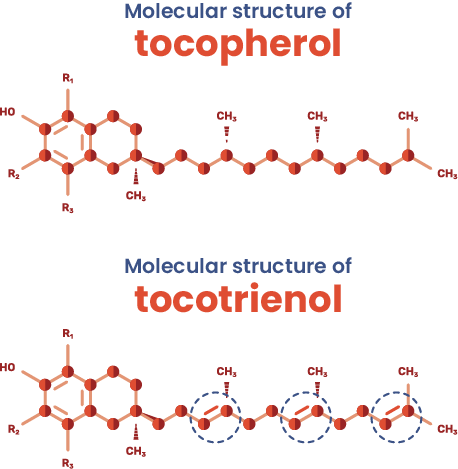
Instead of a saturated phytyl tail, Tocotrienols have an unsaturated side chain making it a stronger antioxidant than Tocopherol.

What Makes It Unique & Effective?
Vitamin E Tocotrienols act as a chain-breaking antioxidant by preventing the oxidation of fats in our bodies and scavenging harmful free radicals.
The unique thing about Vitamin E Tocotrienols is that their unsaturated side chain allows them to penetrate cell membranes more effectively than other types of antioxidants.
Tocotrienols’ unique structure allows it to be more effective at neutralising harmful free radicals in our body that causes neurodegenerative and other inflammatory diseases.
Vitamin E Tocotrienols are proven to reduce inflammation and protect cellular damage from aging or diseases.
Is It Natural?
Yes, palm oil is one of the most abundant natural sources of Vitamin E Tocotrienols.
AvantHealth took it a step further, our products are also vegan-friendly. We also work closely with the Malaysian Palm Oil Board (MPOB) for sustainable extraction of this bioactive.

Health Benefits of
Vitamin E Tocotrienols
Brain & Neuron
• Inhibit progression of white matter lesion3
• Provide neuroprotection in ischemic stroke2
• Reduce diabetic neuropathy pain6
Heart
• Aid regulation of cholesterol12
• Help maintain healthy blood vessels13
Liver
• Improve Non-Alcoholic Fatty Liver Disease (NAFLD)4
• Reduce inflammation and oxidative stress7
Skin
• Reduce wrinkles and acne14
• Reduce inflammation in dermatitis8,9
• Accelerate wound healing8
• Restore skin pigmentation8
Bone
• Protect against osteoporosis11
Hair
• Promote healthy hair growth10
References
[2] Serbinova, E., Kagan, V., Han, D., & Packer, L. (1991). Free radical recycling and intramembrane mobility in the antioxidant properties of alpha-tocopherol and alpha-tocotrienol. Free Radical Biology and Medicine, 10(5), 263-275.
[3] Yang, C., & Jiang, Q. (2019). Vitamin E δ-tocotrienol inhibits TNF-α-stimulated NF-κB activation by up-regulation of anti-inflammatory A20 via modulation of sphingolipid including elevation of intracellular dihydroceramides) The Journal of nutritional biochemistry, 64, 101-109
[4] Rajendran, P., Li, F., Manu, K. A., Shanmugam, M. K., Loo, S. Y., Kumar, A. P., & Sethi, G. (2011). γ‐Tocotrienol is a novel inhibitor of constitutive and inducible STAT3 signalling pathway in human hepatocellular carcinoma: potential role as an antiproliferative, pro‐apoptotic and chemosensitizing agent. British journal of pharmacology, 163(2), 283-298.